Blog

Showing posts with label content marketing. Show all posts

Monday, 19 January 2015

5 Tips for Successful Content Marketing in 2015

The secrets to successful content marketing in 2015 are simple really. Know what makes you different, know your customers THEN engage with your customers in an honest, authentic, clever and original way.


Here's 5 tips to make your content marketing efforts work smarter for you in 2015:

1. People are becoming immune to content so make your content stand out


With so much content freely available these days it's hugely important that your own content stands out from the average, the ordinary and the dull.

During 2014 content marketing grew by over 200% and I estimate that it will continue to grow at the same rate during 2015. With this in mind, brands that create engaging and authentic content with their target audience in mind will benefit from the continued growth of content marketing.

Tip: Make your content stand out with better, more targeted and clever content.


2. Know your customers through customer profiling


If you don’t know who you’re talking to, you won’t know what to say. Who are your customers, where do they hang out, what are their needs, desires and fears? What motivates them to buy?

Tip: Get to know your customers BEFORE you try to market to them.


3. Don't ignore the power of social media


Social media is here to stay so get used to it. Not only will social media give you brand exposure, it will also helps a brand to connect and engage with it's target audience and is essential to support search engine optimisation. Twitter has been putting more emphasis on its indexation and SEO efforts and as a result more tweets are being found on page one of Google. Plus producing well written content is essential to encourage social sharing so brands reach a wider audience.

Tip: Develop content for social media that's brand supportive, targeted & shareable.


4. Content, social media and seo: a marriage made in heaven


Brands must realise that content marketing, social media AND seo are all needed if they want to succeed online. It's no longer one or the other. Great content (written, video, infographics, images) will be 'liked' and 'shared' more on social media and more social media engagement will indicate to Google that the content is deemed to be valuable. Therefore Google will rank valuable content higher in the search results to benefit it's users.

Tip: Integrate SEO, social media and content marketing into your online strategy.


5. Content marketing is more than just writing a few blog articles


Add variety to your content marketing strategy. Written content is great but tweets with images get 150% more re-tweets than those without, by 2017 video will make up almost 70% of consumer internet traffic due to the increase in mobile and tablet use, and around 65% of us respond better to infographics than textual content.

Tip: Mix content types for successful content marketing.

Thanks for reading.

Lisa

Thursday, 27 November 2014

7 online marketing trends you can't ignore in 2015

As you plan for your 2015 online marketing strategy, here are 7 trends that we expect to see and 7 actionable tips to benefit your strategy.

1) Mobile will continue to grow


During 2014 the amount of time we spend on our mobile has overtaken PCs. In a survey of US adults it was found that on average we spend 2 hours and 51 minutes on our phones vs 2 hours and 12 minutes on computers. Many companies have now moved to responsive websites which resize according to the screen the visitor is using but as we go forward into 2015 further optimisations for mobile will be necessary to maintain a share of mobile traffic.

One huge factor is load time. The average load time for a top 10 Google ranking website is 0.99 seconds. Search Engine Land recently reported that Google is experimenting with ways to favour in search results websites that are mobile friendly. Already Google takes into account user behaviour, penalising websites which visitors don’t stay on for long or look at many pages on – two behaviours which are directly affected by load time. Not only are there ranking benefits from a fast loading website, Amazon reported that for every 100 millisecond improvement in website load time, they see a 1% increase in revenue.

Tip 1: Make sure your website is mobile friendly, that it loads in under a second and that your content is easy to read and looks good on all devices.

2) Local SEO will become increasingly important


Research has shown that 50% of customers who performed a local search on their mobile visited a bick-and-mortar store within 24 hours of their search and 18% of these queries led to a sale. The fact remains that many people still prefer physical shopping to online shopping; there’s something about holding a product in your hands. A report by Accenture revealed that 82% of customers say they prefer shopping on the high street than online. Google understands the importance of providing the best local results to users and they’re fine tuning their algorithm to this end.

Tip 2: Local businesses with physical shops must make use of Google+ and local search so that they’re listed in search results for mobile users. (Oh and make sure you apply tip 1: to having a mobile friendly website!)

3) Specific targeting will be needed for success


The days of scatter gun marketing approaches are numbered. Best marketing results will be seen when businesses break down their customer base into segments and market specifically to those segments with the correct voice and tactics to reach that group. It also means more repurposing of content to promote it in a relevant way to each segment. A targeted approach is essential to make sure ROI of time spent creating and money spent advertising content is maximised.

Tip 3: Speak to your customers; find out their wants, needs, lifestyles and habits then tailor your approach to each group. Make sure that whatever you say fits in with the audience you’re saying it to.

4) Content will be expected to entertain


As more and more companies have embraced content marketing our lives have become even more flooded with content. To stand out from the noise content will need to become more than informative, it’ll need to be entertaining. Investment in video is becoming a must for brands that want to stay relevant and cutting edge.

Content is and will remain the driving force behind inbound marketing – especially since over 50% of 19 to 34 year olds will look at 4 or more sources before making a purchase. Now that the effectiveness of content marketing has been demonstrated, distribution will become just as important.

In 2015 we will see more of a focus on re-purposing and distributing to get maximum value from the content we create. Great content marketers will create different thumbnails according to platform, format restrictions and audience preferences so that campaigns consistently look good across all platforms. We’ll also see the same content being promoted in different ways, for example a topic might start out as an article, then an infographic, and then thumbnails and also as a Slideshare. This really follows on from Tip 3: knowing your audience and being specific with how you target different groups.

Tip 4: When you’ve created a great piece of content promote it across several platforms multiple times. Pull out nuggets of information and create interesting, engaging social posts about your content. Use images and video to create something that will stand out.

5) We’ll see more paid advertising


We’ve seen the rise and growth of social media success with many businesses adopting social for customer service and to reach out to new prospects. Now however there is increasing need to advertise on social platforms. With Facebook’s algorithm update it’s become increasingly hard to get content in front of consumers without advertising. This algorithm change lead to a 44% decline in brand content in users’ new feeds. LinkedIn, Twitter and Pinterest have followed Facebook and have all launched sponsored ads to put content in front of a specified group.

Tip 5: Budget for sponsored ads on social platforms, even £5 a day can dramatically increase your reach on Facebook. Once you invest, use analytics to measure your success and fine tune your strategy.

6) And more user reviews


Consumer reviews are certainly not a new trend but what we will see increasingly is companies asking customers to share their experiences become brand advocates. User generated content is invaluable. In the words of Jeff Bullas: “Reviews are a source of truth that will live on the web indefinitely”. It’s one thing saying you provide a great product or service, how much more valuable is it if your customers sing your praises for you? According to Neil Patel, customers are ready and willing to talk about great buying experiences: “50% will write about positive experiences, and 39% will write about negative”. Customers want you to wow them, and when you do they want to tell people about it.

There are various ways that you can collect reviews; on Google+, Trustpilot or with onsite review functionality. Collect reviews on Google+ one of the results when customers type your brand into Google will be your Google+ page with your shinning reviews. Companies that grasp this in 2015 will benefit from higher levels of trust and, consequently, better conversion rates.

Tip 6: Start asking customers to leave reviews on your Google+ page. We’ve written a couple of articles on the topic: 11 ways to encourage customer reviews and User Reviews: why they’re essential for e-commerce SEO.

7) We’ll expect increased personalisation


Another trend is increasing personalisation. More than ever customers are expecting companies to reach out to them personally. This is especially true of millennials who have grown up in the digital age and now have money to spend. They expect companies to court them for their business, they want to feel valued and personalisation is one way to do this.

Tip 7: Start sending out personalised follow up emails after cart abandonment. It shows that you do really value their purchase.

Thank you for reading.

Wednesday, 15 October 2014

11 of the best internet marketing infographics

Infographics have really surged in popularity over the last couple of years. And it’s no wonder really as visuals make a topic easy to understand and instantly digestible.

We've picked out 11 of our favourite infographics. Together they create a beginners guide to internet marketing, search engine optimisation, content marketing and social media marketing.

If you’re new to internet marketing, these infographics are a great place to start. And if you know your way around the world of internet marketing pretty well, we hope this blog post forms a useful bank of statistics for you.

1) The Periodic Table of SEO Success Factors (published 2013)


This infographic clearly explains the most important factors involved in SEO. It splits these factors into two groups, On-The-Page and Off-The-Page Factors with an explanation for each. Rating and colour coding the different factors between +3 for really effective SEO tactics and -3 for harmful practise, makes it obvious which to use and which to steer clear of.


Take away: Make sure you (or your SEO agency) only employ SEO tactics that have a positive rating in this table.

2) The Blogconomy (published August 2013)


The infographic starts with the heading “why blogging is good for your business”. Then it goes on to list over 50 different stats/pieces of information on blogging. Thanks to the hard work done by ignitespot collecting all of these valuable figures into one resource, it’s easy to see why and how blogging will grow your business.

Click for full infographic.

Take away: If you don’t blog, start now. It generates leads and will boost your website’s visibility in Google search results.

3) The Ultimate Guide to Social Media Image Dimensions (published February 2013)


We really like this infographic because it’s so useful! Anyone setting up or refreshing their company’s social media profiles will need to navigate the tricky world of multiple profile image and channel art dimensions. Thankfully, this lovely infographic collects all of this information in one place.

Click for full infographic.

Take away: Don’t settle for stretched images on your social platforms. Get them right.

4) The Best Times to Tweet, Pin, Tumble and Post (published May 2014)


One of the most common questions our clients ask on the topic of social media, is when should I Tweet, Facebook or post to Google+, this infographic puts this information at the tip of your fingers for the 6 most used social platforms.

Click for full infographic.

Take away: Be strategic about when you post on social media to see more engagement.

5) 22 ways to Create Compelling Content (published February 2012)


We talk a lot about content here at angelfysh. And rightly so. It’s one of THE most important factors when it comes to getting your website to the top of Google search results. unfortunately, deciding what to write about isn't always easy. This infographic has 22 ways for you to get your creative juices flowing.

Click for full infographic.

Take away: Get blogging!

6) How to Increase LinkedIn Engagement by 386% (published December 2013)


This infographic has some great tips on how to take your LinkedIn use from personal networking to generating leads and revenue for your business. It includes useful information such as when to post, and what to talk about.

Click to see full infographic.

Take away: Include links or images in your LinkedIn updates.

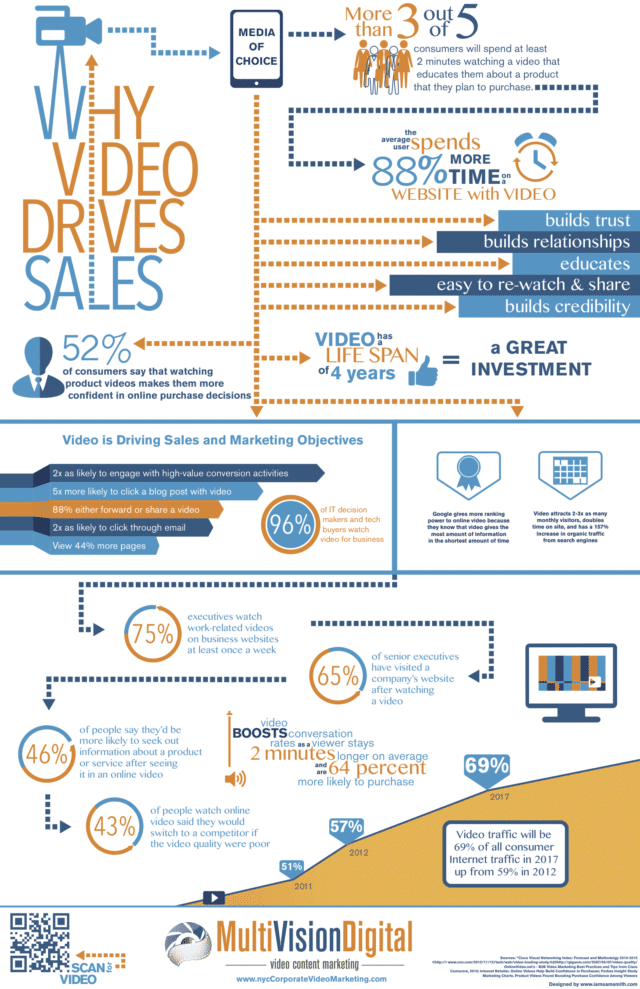
7) Why Video Drives Sales (published October 2013)


Content marketing isn’t just about written content, it includes video too. This infographic shows why every company must include videos as part of their marketing strategy – e.g. 75% of executives watch work-related videos on business websites at least once a week. And! Video traffic will account for a huge 69% of all consumer internet traffic by 2017.

Click to see full infographic.

Take away: Don’t just leave video to the ‘big players’ in your industry. Take the lead and add videos into your internet marketing strategy.

8) Mobile Marketing (published May 2012)


Did you know that 46% of users who view a product on their phone are actually standing in the store? And by 2015 43% of mobile users will make purchase on their phones. This infographic contains loads of great statistics on mobile usage which you can use to inform your mobile marketing strategy.

Click to see full infographic.

Take away: Make sure your website is responsive. A responsive website will resize to fit the screen (laptop, tablet, mobile etc.) being used to view the website.

9) The New Multi-Screen World (published August 2012)


Google has created this neat little infographic which contains some really interesting information on cross-platform consumer behaviour. By cross platform we mean shoppers who use more than one device in their buying journey. For example, 67% of people use two devices when shopping such as a phone and a computer.


Take away: Make sure your website is responsive, easy to navigate and easy to checkout on multiple devices.

10) Why Visual content Marketing Delivers Results (published September 2014)


This is really an infographic on why infographics work! If you’re still to be convinced of their merit here are some statistics that will leave you without any doubt of their effectiveness to engage.

Click for full infographic.

Take away: What subject could you create an infographic on to engage new leads or customers?

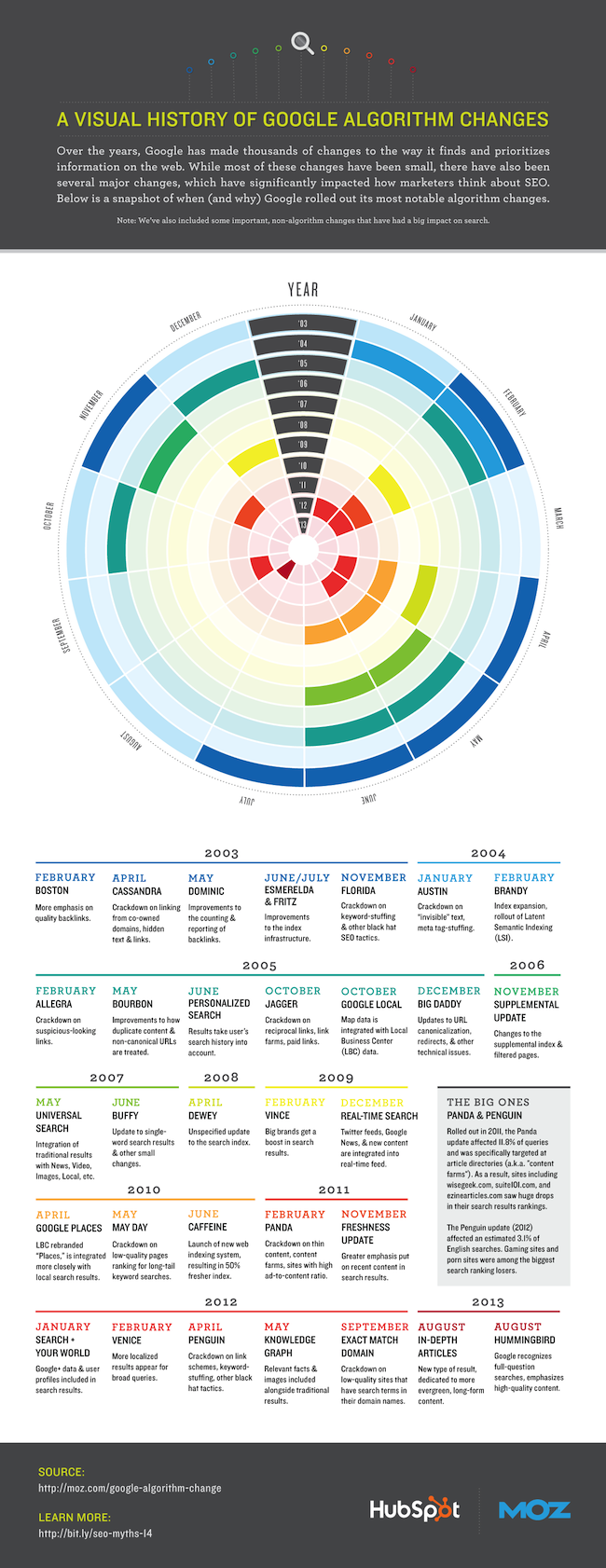
11) A Visual History of Google Algorithm Changes (published February 2014)


This infographic will give you a snapshot overview of the background of SEO today. It eloquently summarises the changes Google has been making to the way it finds and ranks websites over the last decade.

Click for full infographic.

Take away: Google will favour websites with quality content and quality links.


We hope you've found this interesting! If you've got a favourite infographic, please let us know in the comments below. Please also share this post with your own followers. Thank you.

Monday, 28 July 2014

16 stats that show the value of SEO, Content Marketing and Social Media

Anyone else love a good juicy statistic? We certainly do!

In this blog post we've rounded up 16 stats for you that demonstrate the value of SEO, content marketing and social media - three things which go hand-in-hand with internet marketing and e-commerce success.

SEO statistics


Outbound leads cost 61% more than inbound leads. An example of an outbound lead could be direct mail or print ads, sources of inbound leads include SEO and content marketing. HubSpot.

SEO leads have a 14.6% close rate, while outbound leads have a 1.7% close rate. Search Engine Journal.

44% of online shoppers start their buying journey with a search engine. IPSOS.

75% of users never scroll past the first page of search results. Hubspot.

70-80% of users searching on Google and Bing ignore paid ads. Search Engine Journal.

Search is the largest traffic driver providing 41% of visitors compared to 11% coming from Social Media. Search Engine Land.

Content Marketing statistics


Companies that blog have on average 4 times more indexed pages, pages that Google has deemed valuable enough to store in its index. Social Media Today.

Companies with blogs on their websites have on average 97% more back links. Social Media Today.

90% of consumers find customer content useful and 81%  trust advice from blogs. Social Media Today.

Social Media statistics


There are 3.2 billion interactions on Facebook and over half a billion tweets published every single day. KissMetrics.

77% of B2C companies and 43% of B2B companies have acquired customers on Facebook. HubSpot.

34% of marketers have generated leads using Twitter. Digital Buzz Blog.

Marketers reported that demand for social media marketing increased by over 60% in 2013. Moz.

71% of social media users are more likely to purchase from brands they follow online. Balihoo.

Interesting content is one of the top three reasons customers follow brands on social media. Social Media Today.

50% of Companies struggling with SEO aren’t integrating social media. Search Engine Land.

...

We hope you've found this collection of statistics both interesting and helpful to your online marketing efforts! Let us know if you've got any SEO stats you'd like to share by commenting below.


Monday, 21 July 2014

6 steps to fit blogging into your busy schedule

Running a business takes a lot of time, for many businesses writing blog posts can come way down their list of priorities. Which is a shame because creating interesting content for your website is so important to its success in search engines – so how can you streamline your blog writing process so it fits into your busy schedule?

1. Decide how often


Consistency is key. Decide how often you want to schedule blog posts, which day of the weeks and what time you want your blog posts to go out. Hubspot research showed that you’re likely to get more views, links and comments if you publish in the morning.

Once you’ve decided on your schedule you need to stick to it! Block out time in your calendar and be consistent with it.

If you can have a couple of back up articles on the ready then you'll have something to fall back on if you miss the odd deadline.

2. Always be on the lookout for ideas


Have somewhere to store your ideas. It’s hard to think up ideas on the spot so collect and jot down ideas through the week when they come to you. These could be questions that customers are always calling to ask, inspired by an interesting article you’ve read or a different spin of on article that’s done well on a competitors blog.

The key to a successful blog post is to create value for the reader. Every single blog post you write should help your reader in some way. Every single one.  Use this rule to judge if your article idea is a good one… or not.

You’ll end up with a bank of ideas to choose from when you come to putting pen to paper – or fingers to keyboard. Spend just 5-10 minutes choosing one of your ideas.

We’ve also written a whole blog post on blog post ideas here.

3. Start with an outline


First decide on your title, keep it under 65characters and make sure it’s compelling. There are some more tips on blog headlines here.

Next write your introduction, conclusion and list the points to include in the body of the blog post.
Your introduction should be clear and engaging; it should tell your reader why they need to read the post and what it will teach them.

Conclusions should be a simple summary of the main points from your post and include a call to action. Calls to actions are really important, if the reader has enjoyed your post you want to keep them on your website moving along the journey to becoming a customer. The call to action could link to a related product, webpage, or another relevant blog post.

4. Write


Now it's all about adding meat to the structure you have and since you’ve already decided what your points are you’ve already done the hard bit.

When you’re writing be sure to keep things simple. That means no jargon! Jargon only alienates readers, you want to reach out to them.

Keep your writing to the point, if you can say it in half the words then why don’t you? Longer content is only a good thing if it tells the reader more.

Back up what you say with stats or links to studies. This both substantiates what you’re saying and it tells the reader that you are well read on the subject.

5. Get someone else to proof and schedule it


There are a couple of reasons for this. Firstly, it’s really hard to spot your own typos because you know the article you’ve written too well. A fresh pair of eyes is needed.

Secondly, proofing, adding pictures and scheduling a blog post can take an extra 30 minutes – which is time you probably don’t have when you’re busy running a business. Getting a member of staff  to do this for you solves this problem.

6. Don’t forget to promote your content


If you’re a busy person, you want to see the largest return for every minute you spend on something.

Promoting your blog posts will not only get it in front of more people it will also make it more discoverable in search results. You can promote your blog posts by including a link from your newsletter, Tweeting it, putting it on Google+ and Facebook. Again, this is something you can delegate to one of your team. (We could actually write several articles on this... I'll add it to my list of blog post ideas!)

...

So that’s it; decide how often, get your creative juices running with ideas, outline, write, get help proofing and promote your articles.

Hope we’ve made blogging sound a little less scary and a lot more manageable! It really is something that can benefit your businesses’ online presence tremendously so if you can crack the art of producing great content efficiently, you’re on to a winner.

Friday, 30 May 2014

18 stats to help you write the perfect blog post

... sounds like a big claim... but these 18 stats will shed light on how to get your blog posts more social shares and therefore back links (which are so important to help you rank well in Google). In this post we'll look at five easily measurable factors and show how they can be used to make your blogging a success.

Article length


These few stats will help you answer questions like: how long is the optimum length of a blog post? And does the length of your content matter?

1. Articles that are over 1,500 words long receive on average 68.1% more tweets and 22.6% more Facebook likes... read more.

2. Longer content can convert up to 45% better... read more.

3. The average content length for a Google top ten ranking is 2,000 words or more... read more.

 
(With all of this said, we’re not giving you an excuse to ramble! If your post is naturally long then great but don't waffle just to make your content longer.)


Blog headlines


The headline is your mini sales pitch to get people to click through to your blog, it's your moment to shine. So what works best?

4. 77% of press releases indexed in Google news had headlines that were too long, and so appeared truncated... read more. So make sure when you're writing to keep your headlines under 65 characters long.

5. More than 1 in 4 of all headlines won’t fit into a tweet! ... read more. This is another reason to follow the 65 character golden rule.

6. The blog title length sweet spot is between 14 and 16 words long with up to 5 times more back links than a title with 24 words... read more.


Blog articles with lists


List blog posts are everywhere. Have they been overdone? Maybe… but the stats show that there are a few compelling reasons for their popularity:

7. A study by SEOMoz showed that blog articles using lists receive twice as many back links... read more.

8. 22 out of 25 of Econsultancy’s top 25 blog posts of 2013 were lists blog posts... read more.


Blog articles with images


The average number of  images per blog post is 3.2 per post but are there any benefits to be gained by adding images?

9. 40% of us are visual learners, we’ll respond better to visuals than plain text... read more.

10. Articles with images get 94% more views... read more.

11. Photos are linked to twice as much as text updates... read more.

12. Infographics can help businesses grow traffic by 12% more than those who don’t use them... read more.


Blog articles with videos


We would all (well most of us) probably guess that well produced videos would have a positive affect on our website... but producing video content does take a lot of effort, so is it worth it?

13. Pages with videos are 50 times more likely to appear in Google search results... read more.

14. Visitors spend twice as long on pages with video content... read more.

15. The percentage of people who will click on a video in Google search results is 41% higher than for normal search results... read more.

16. 700+ videos are shared on Twitter every minute... read more.

17. 76% of YouTube users tell someone about a video they have seen... read more.

18. 75% of executives says that they watch more than one work related video a week... read more.


To round things off, SEOMoz gave us this stat: blog posts with videos, images and lists attract up to 6 times more back links than a plain post. We're talking to ourselves just as much as anyone else with this post... we'll be adding more videos in future!


We hope this blog post has given you a few easily actionable tips to get your blog articles more visibility, more back links and more social shares.